Cloud is not always the answer
Cloud storage adds an external dependency and a third-party breach surface. PassM3nage keeps credential data local and under your control.
PassM3nage
Offline-first Open Source Password Manager
Your passwords. Your vault. Your control.
Offline-first password manager built with AES-256-GCM, Argon2id and zero telemetry.
Repository available on GitHub for audit, release assets, and installation instructions.
Keep vault files on your device. No cloud accounts, no server-side storage.
Open source code and reproducible builds let reviewers verify every step.
AES-256-GCM encryption, Argon2id key derivation, and fast local search in a compact tool.
Why PassM3nage
Cloud storage adds an external dependency and a third-party breach surface. PassM3nage keeps credential data local and under your control.
Open source repositories and build artifacts allow independent review of the vault format, encryption, and tool behavior.
There is no background syncing, no telemetry, and no account registration. Vault files are managed by you.
Why another password manager?
PassM3nage stores encrypted vault files on your device. There is no mandatory account, no silent sync and no hidden server component.
The binary is built to run locally and does not phone home. Your usage is your own, and the repository is the source of truth.
The project is transparent, MIT licensed, and intended for technical users who want verifiable behavior.
Threat Model
Features
Everything runs locally. No network connectivity is required to open or manage your vault.
Documented binary format with versioning for long-term compatibility and auditability.
Sensitive secrets are wrapped in secrecy types and cleared from memory when dropped.
Vault records are encrypted using authenticated AES-256-GCM to protect confidentiality and integrity.
Master passwords are processed with Argon2id to slow brute-force attempts and resist GPU cracking.
PassM3nage does not collect usage data. The project is designed to avoid background reporting entirely.
Licensed under MIT with source code available for direct review and contribution.
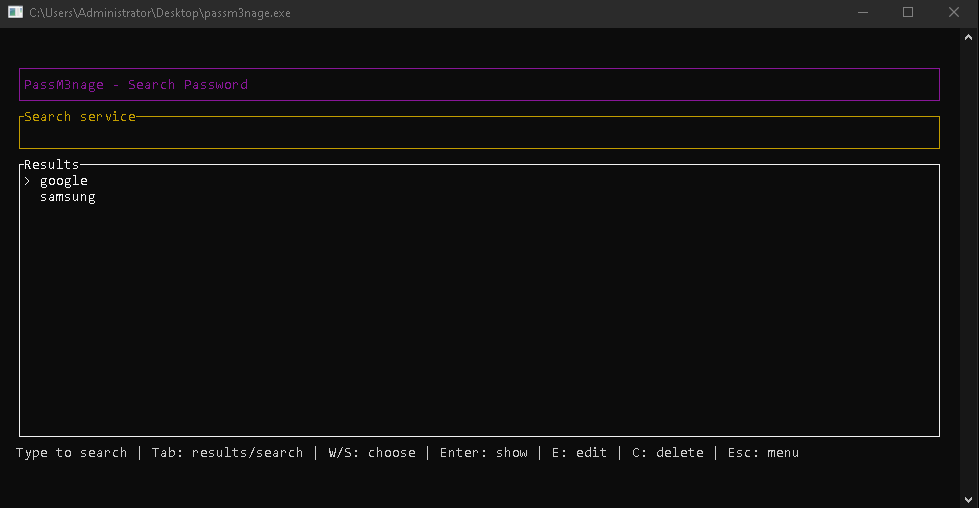
Search within your local vault instantly to find service names and credential entries without waiting on remote services.
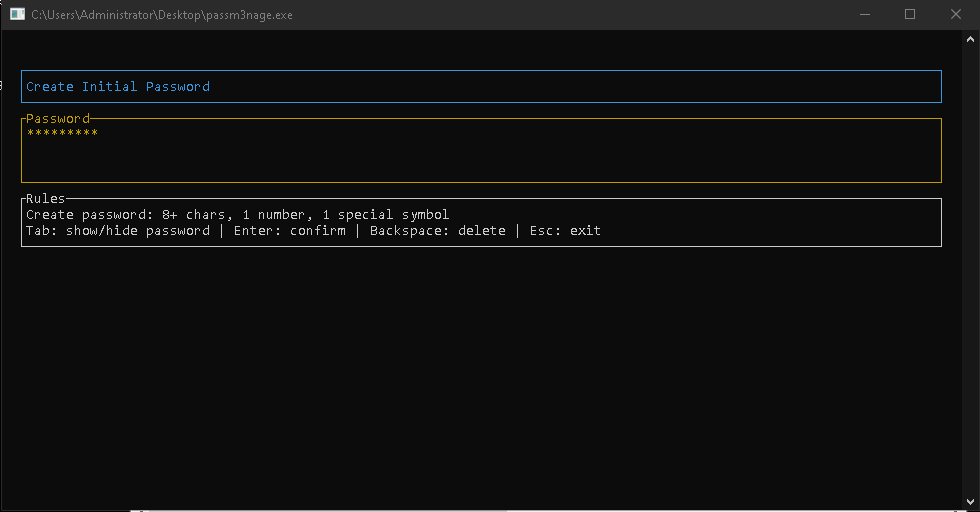
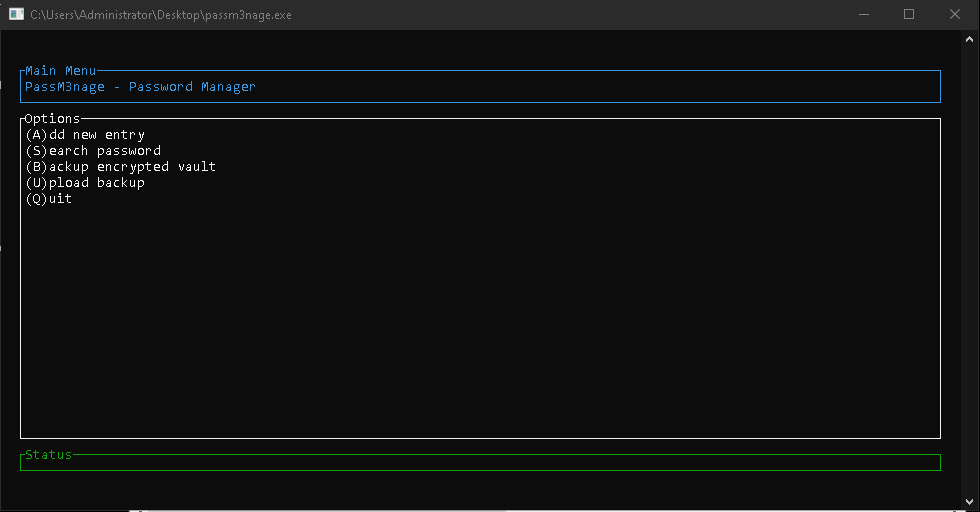
Screenshots
Security
The vault file is encrypted with AES-256-GCM and integrity is verified before any data is accepted.
The master password is never stored. It derives the key material used to decrypt the vault and login metadata.
Master password keys are derived with Argon2id, a memory-hard function that raises the cost of offline cracking.
Credentials are handled with secrecy-safe types and cleared from memory when no longer required.
PassM3nage is intended for users who want a local security model that is explicit about what it protects and what it does not.
Open Source
PassM3nage is published under an open source license with the source repository available on GitHub. That means security reviewers, auditors, and users can verify the implementation directly.
The project is built for reproducibility: the vault format, encryption primitives, and runtime behavior are all visible in source control.
Community review is the strongest control against hidden behavior. If you have an insight or improvement, it can be submitted through the repository.
View the repositoryDownload
Available now from GitHub Releases as a portable executable archive.
Download Windows buildPlanned. Linux support is on the roadmap and will be published when ready.
Check ReleasesPlanned. macOS builds are expected in a later release cycle.
PlannedFAQ
Yes. PassM3nage is free to download, use, and modify under its open source license.
Offline-first means your vault data never depends on remote services. This reduces external attack surface and keeps you in control of your credentials.
PassM3nage does not include built-in sync. You can sync encrypted vault files through your own tools if you accept the risks and trust the sync channel.
Yes. The full source code is hosted on GitHub for review, auditing, and contribution.
PassM3nage uses AES-256-GCM for vault encryption and Argon2id for master password key derivation.